
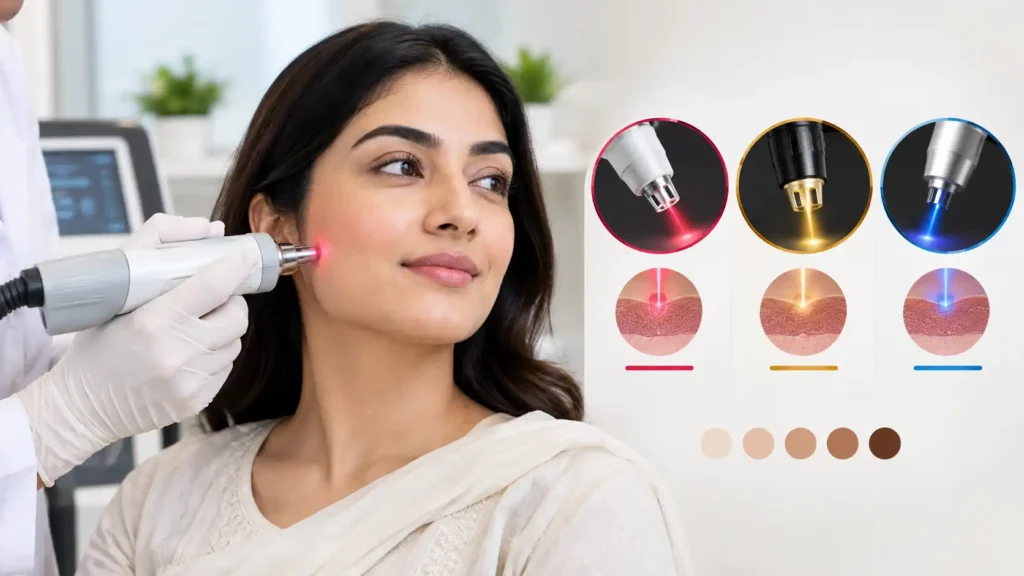
Laser choice decides both safety and results in laser hair removal. Pakistani skin usually sits between Fitzpatrick types III and V, which means more melanin in the skin competing with melanin in the hair. The wrong wavelength burns or darkens skin. The right one destroys follicles while the surface stays safe. This guide compares the three main hair removal lasers on brown skin with a clear decision framework.
How Laser Hair Removal Works
Laser hair removal uses selective photothermolysis. A laser beam at a specific wavelength targets melanin in the hair shaft and bulb. The melanin absorbs light, converts it to heat and damages the follicle’s ability to regrow hair.
The Brown Skin Challenge
Skin melanin also absorbs laser energy. On darker skin, a short wavelength heats the epidermis before it reaches the follicle. Longer wavelengths penetrate deeper and bypass much of the surface melanin. This is why wavelength, pulse duration and cooling matter more for Pakistani patients than for fair-skinned patients.
Fitzpatrick Skin Types in Pakistan
| Fitzpatrick Type | Description | Common in Pakistan |
| Type III | Light brown, sometimes burns, tans gradually | Common in northern regions |
| Type IV | Moderate brown, rarely burns, tans easily | Very common in Karachi |
| Type V | Dark brown, very rarely burns | Common in Karachi and Sindh |
| Type VI | Deeply pigmented | Less common |
The Three Lasers Compared
Alexandrite Laser (755 nm)
The Alexandrite laser has high melanin absorption, which makes it very effective on fine and light-brown hair in fair skin. On Fitzpatrick IV to V skin, the same absorption raises the risk of burns, blisters and pigment change. Clinicians use it on brown skin only with long pulse durations, lower fluence and strong cooling, and many avoid it above type IV.
Strength: fast results on fine hair in light skin.
Limitation: highest risk on darker Pakistani skin.
Diode Laser (805 to 810 nm)
The diode laser sits in the middle of the spectrum. It penetrates deeper than Alexandrite and balances follicle absorption with epidermal safety. Modern diode platforms use contact cooling and larger spot sizes, which make treatment comfortable for types III to V. Triple-wavelength diode systems combine 755, 810 and 1064 nm in one handpiece to target hair at several depths.
Strength: versatile, effective on most Pakistani skin and hair types.
Limitation: less effective on very fine hair.
Nd:YAG Laser (1064 nm)
The long-pulsed Nd:YAG laser has the longest wavelength of the three. It has the lowest melanin absorption, so it passes the skin surface and reaches deep follicles safely. It is the safest choice for Fitzpatrick V and VI and for tanned skin. Because absorption is lower, it needs higher energy and can feel hotter, and it may need more sessions for fine hair.
Strength: safest for dark and tanned skin, excellent for coarse deep hair such as beard and bikini areas.
Limitation: more discomfort, weaker on fine hair.
Technical Specification Comparison
| Specification | Alexandrite | Diode | Nd:YAG |
| Wavelength | 755 nm | 805 to 810 nm | 1064 nm |
| Melanin absorption | Highest | Moderate | Lowest |
| Penetration depth | Shallow to mid | Mid to deep | Deepest |
| Safe Fitzpatrick range | I to III (IV with caution) | I to V | I to VI |
| Best hair type | Fine, light brown | Medium to coarse | Coarse, deep |
| Pain level | Moderate | Low to moderate with cooling | Moderate to high |
| PIH risk on brown skin | High | Low with correct settings | Lowest |
| Typical sessions for brown skin | 6 to 8 | 6 to 8 | 8 to 10 |
Specification-to-Application Matching Table
| Patient Profile | Best Laser Choice | Why |
| Type III skin, fine dark facial hair | Diode or Alexandrite | Good absorption, low risk on lighter skin |
| Type IV skin, full body | Diode | Balanced safety and speed |
| Type V skin, any area | Nd:YAG or diode with conservative settings | Lowest surface heating |
| Tanned skin after summer | Nd:YAG | Safe on recently tanned skin |
| Men’s beard shaping and back hair | Nd:YAG or diode | Deep coarse follicles |
| Bikini and underarm, dark skin | Nd:YAG | Deep follicles, pigmented skin folds |
| PCOS-related chin hair | Diode or Nd:YAG plus hormonal review | Hormone-driven regrowth |
| Blonde, grey or white hair | None effective | No melanin to target |
Karachi Environment and Laser Safety Matrix
| Local Factor | Laser Risk | Clinical Adjustment |
| Year-round tanning from UV | Burns and pigment change | Nd:YAG or reduced diode energy, 2-week sun break |
| Humidity and sweating | Post-laser folliculitis | Cool compress, loose cotton clothing |
| Summer heat | Prolonged redness | Evening appointments, extended cooling |
| Waxing and threading habits | No hair root for laser to target | Shave only, stop waxing 4 weeks before |
| Home bleach creams | Sensitised skin | Stop 1 to 2 weeks before sessions |
Operator Skill Matters as Much as the Machine
A premium laser in untrained hands still causes burns. Ask these questions before booking:
- Is a dermatologist or trained physician supervising sessions?
- Will you do a patch test before the first full session?
- How do you set energy for my Fitzpatrick type?
- What cooling system does the device use?
- How is the treatment plan adjusted between sessions?
Our advanced laser hair reduction protocol starts with a skin assessment and patch test, then sets energy to your skin type and hair density.
Cost Comparison and ROI
Laser type affects price less than area size and session count. Indicative 2026 Karachi ranges are covered in our detailed laser hair removal price guide.
| Method | 5-Year Cost Estimate (PKR) | Outcome |
| Monthly salon waxing, full body | 300,000 to 500,000 | Temporary, ingrown hairs and pigmentation |
| Laser course (6 to 8 sessions) + yearly top-ups | 180,000 to 350,000 | Long-term hair reduction |
| Cheap IPL at unsupervised centres | 80,000 to 150,000 + repair costs | Inconsistent results, burn risk |
What Results to Expect
Laser hair removal delivers long-term reduction, commonly 70% to 90% after a full course. Remaining hair grows finer and lighter. Hormonal areas may need maintenance sessions once or twice a year. Read more in our guide on whether laser hair removal is permanent for Pakistani skin types.
Frequently Asked Questions
Which laser is best for brown Pakistani skin?
Diode suits most type III to V skin. Nd:YAG is safest for type V, VI and tanned skin.
Is Alexandrite laser safe for Pakistani skin?
It can be used on lighter Pakistani skin with careful settings. Many clinicians avoid it for darker skin types.
Does Nd:YAG laser hurt more?
It can feel hotter. Contact cooling and numbing cream reduce discomfort.
Is IPL the same as laser?
No. IPL uses broad-spectrum light, which is less predictable on brown skin.
Can men use these lasers for beard shaping?
Yes. Diode and Nd:YAG work well on coarse beard hair. See our guide to laser hair removal for men in Karachi.
Choose the Right Laser With a Skin-Type Assessment
LifeStyle Clinic in North Nazimabad matches laser settings to your Fitzpatrick type, hair colour and treatment area. Explore full body laser hair removal or book an appointment for a free consultation and patch test. Call 0312 0233316, Monday to Saturday, 11am to 9pm.