

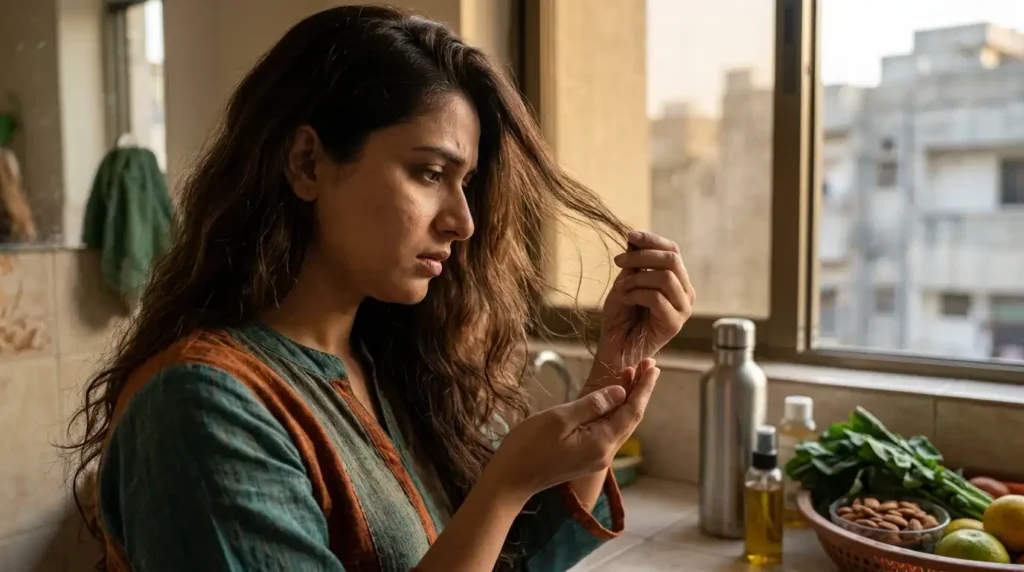
Start with the part everyone gets wrong. Karachi’s water almost certainly makes your hair look and feel worse. It roughens the cuticle, deposits minerals along the shaft, causes tangling and breakage, and irritates the scalp. What the published evidence does not support is that hard water kills follicles or causes true hair loss. If your parting is widening or your density is dropping, the cause is far more likely to be androgenetic alopecia, telogen effluvium, iron deficiency or thyroid dysfunction. Blaming the water is the most expensive mistake you can make, because it costs you months.
That said, Karachi genuinely does present a stacked set of conditions. Here are the actual numbers.
Karachi Water: The District Level Picture
Karachi does not have one water quality. It has five, and they are not close. A study sampling all five districts found the following.
| District | Notable readings | Samples failing potability standards |
| Malir | Highest recorded total dissolved solids at 8,960 mg/L. Highest chloride at 3,240 mg/L | 83.3 percent |
| Karachi West | Highest recorded total hardness at 4,460 mg/L | 61.3 percent |
| Karachi South | Elevated turbidity and chloride | 56.7 percent |
| Karachi East | Wide hardness range across sampling points | 50.0 percent |
| Karachi Central | Best performing district in the sample | 41.9 percent |
Elevated turbidity and chloride were found across all five districts, consistent with saline intrusion into groundwater. Separately, a Supreme Court judicial commission task force reported that roughly 90 percent of Karachi samples it tested were unfit for human consumption, and a national regulator assessment reported around 93 percent of Karachi drinking water contaminated. Chlorination is also inconsistent: monitoring found around 40 percent of samples from Gulshan-e-Iqbal, North Karachi and Orangi Town lacked adequate chlorination, and a substantial share of the city’s daily supply is distributed without filtration. Around a quarter of Karachi households rely on tanker water, priced at a large multiple of municipal supply and of variable source quality.
What this actually does to hair
| Effect | Evidence position | What you notice |
| Mineral deposition on the hair shaft | Demonstrated. Magnesium deposition is significantly higher with hard water | Rough, dull, straw like texture. Shampoo lathers poorly |
| Reduced tensile strength | Mixed. One study found reduced strength with hard water, another found no significant difference | Snapping mid shaft, split ends, shorter hairs in the shower |
| Visible structural damage under electron microscopy | Not demonstrated over a three week exposure study | Damage appears cumulative and slow, not acute |
| Scalp irritation and residue | Reported, plausible with high mineral and chloride load | Itching, flaking, product build up |
| Follicular death and true hair loss | Not supported by the evidence | If density is dropping, look elsewhere |
The practical distinction: breakage produces short broken hairs of varying lengths and a rougher texture, while shedding produces full length hairs with a white bulb at the root. Look at what is actually coming out. It tells you which problem you have.
Nutritional Deficiency: The Cause That Actually Moves the Needle
This is where Karachi hair loss is genuinely driven, and it is treatable. National survey data for Pakistan reports the following in women of reproductive age.
| Deficiency | Prevalence | Relevance to hair |
| Vitamin D deficiency | Around 80 percent of women of reproductive age | Associated with telogen effluvium and alopecia areata |
| Anaemia | Around 43 percent of women of reproductive age, and around 55 percent of adolescent girls | A leading cause of diffuse shedding in women |
| Iron deficiency | Around 34 percent of women of reproductive age, higher in pregnancy | Low ferritin impairs the anagen phase |
| Zinc deficiency | Around 22 percent of women of reproductive age | Required for follicular protein synthesis |
A population survey of asymptomatic adults in Karachi specifically found roughly 84 percent below the vitamin D sufficiency threshold, with a median serum level well inside the deficient range. Protein intake shows a similar income gradient: national mean intake sits near adequacy, but the lowest income quarter of households consumes roughly 79 percent of required protein, alongside a calorie shortfall.
Translated into practice: if you live in Karachi and you are shedding, there is a substantial statistical chance that a blood test explains part of it. Test before you buy any procedure. Book a medical skin consultation that includes scalp examination and appropriate blood work.
Heat, Humidity and Pollution
| Karachi factor | Figure | Effect on hair and scalp |
| Humidity, August | Around 72 percent | Sweat retention, occlusion, seborrhoeic dermatitis flares, fungal overgrowth |
| Humidity, December | Around 45 to 54 percent | Lower flare risk. Many patients report the calmest scalp of the year |
| Daily highs, April to September | 32 to 36 degrees Celsius | Frequent washing strips lipids, aggravating dryness and irritation |
| UV index, July and August | 12 | Hair protein and pigment degradation, scalp burn on exposed partings |
| Annual PM2.5 | Approximately 46 micrograms per cubic metre in 2024, several times the WHO guideline | Particulate deposition on the scalp, oxidative stress, more frequent washing |
None of these causes pattern baldness. All of them worsen scalp condition, which in turn worsens shedding in someone already predisposed. Dandruff and seborrhoeic dermatitis are the most common downstream problem, and a persistently inflamed scalp is a poor environment for hair growth.
The Real Causes of Karachi Hair Loss, Ranked
| Cause | Pattern | Who it affects | Reversible? |
| Androgenetic alopecia | Receding temples and crown in men, widening parting in women | The most common cause. Pakistani data shows around 37 percent of men in the moderate range and around 28 percent in the severe range | Slowed and partly reversed, not cured |
| Telogen effluvium | Diffuse shedding across the whole scalp, 2 to 3 months after a trigger | Post illness, post partum, crash dieting, severe stress, high fever | Yes, usually within 6 to 9 months once the trigger is removed |
| Iron deficiency | Diffuse thinning, often with fatigue | Women, adolescents | Yes |
| Thyroid dysfunction | Diffuse thinning, texture change | Both sexes, more common in women | Yes, once treated |
| Vitamin D deficiency | Diffuse shedding | Highly prevalent in Karachi | Yes |
| Seborrhoeic dermatitis | Itching, flaking, redness with shedding | Aggravated by humidity | Yes, controlled with treatment |
| Traction alopecia | Loss at the hairline and temples | Tight hijab pins, tight buns, braids, extensions | Yes if caught early, permanent if prolonged |
| Hard water | Breakage and roughness, not density loss | Everyone in Karachi | Yes, cosmetically |
Self Assessment Before You Book Anything
- The pillow and drain test. Losing 50 to 100 hairs a day is normal. Consistently more than that, over weeks, is not.
- Look at the root. A small white bulb means the hair shed from the follicle. No bulb, and a blunt or frayed end, means breakage.
- Photograph your parting. Same light, same angle, monthly. This is the only reliable way to know whether you are progressing or fluctuating.
- Check the pattern. Diffuse across the whole scalp suggests effluvium or a systemic cause. Temple, crown or parting specifically suggests androgenetic alopecia.
- Check the timeline. Telogen effluvium follows its trigger by two to three months. Think back to a season.
- Check for symptoms. Itching, redness, scaling, pain or pustules mean a scalp condition needs treating first.
What Actually Helps, in Order of Impact
| Action | Approximate cost | Impact |
| Blood tests: full blood count, ferritin, TSH, vitamin D | Modest one off cost | Highest. Identifies correctable causes before you spend on procedures |
| Correct iron, vitamin D and protein intake | Low, ongoing | High where deficiency is present |
| Treat scalp inflammation and dandruff | Low | High. An inflamed scalp undermines every other treatment |
| Medical therapy for androgenetic alopecia | Approximately PKR 800 to 900 a month for topical minoxidil | High for pattern loss, evidence established |
| Shower filter or final rinse with filtered water | Low to moderate | Cosmetic. Improves texture and manageability, does not change density |
| PRP hair restoration | PKR 8,000 to 35,000 per session | Moderate to high for miniaturising follicles, requires maintenance |
| Scalp mesotherapy | PKR 7,000 to 25,000 per session | Adjunctive, often combined with PRP |
| Exosome hair therapy and stem cell hair therapy | Higher cost per session | Newer modalities. Ask about expected benefit and evidence before committing |
Practical Karachi Hair Routine
- Final rinse. Rinse with filtered or boiled and cooled water where practical. This is the cheapest way to reduce mineral deposition.
- Wash frequency. In summer humidity, washing every one to two days is appropriate. Use a mild sulphate free cleanser and focus on the scalp rather than the lengths.
- Chelating shampoo. Once every two to four weeks remove mineral build up. Follow with a conditioner.
- Dry properly. A damp scalp under a covering in 72 percent humidity encourages fungal overgrowth. Dry fully before covering.
- Loosen the tension. Tight buns, tight pins and heavy extensions cause traction alopecia at the hairline. This is preventable and, once established, often permanent.
- Protect the parting. At UV index 12, an exposed parting burns. Cover it or use a scalp sunscreen.
- Sea water. Rinse immediately after a beach visit. Salt is highly drying.
- Protein. Hair is largely keratin. Ensure adequate daily protein, particularly if you are dieting.
When to See a Doctor Rather Than Buy a Shampoo
- Shedding that has continued for more than three months.
- A visibly widening parting or receding hairline.
- Patchy, circular loss, which needs assessment for alopecia areata.
- Scalp pain, burning, pustules, scarring or shiny smooth patches, which may indicate scarring alopecia. This is urgent, because it is irreversible once established.
- Shedding with fatigue, weight change, irregular periods or cold intolerance.
- Any hair loss in a child.
Telogen Effluvium: The Karachi Timeline
This is the most misdiagnosed hair problem in the city, because the trigger happens two to three months before the shedding starts, and by then nobody connects the two. Work backwards from when your shedding began.
| Trigger | Delay before shedding starts | Typical recovery | Common in Karachi because |
| High fever, dengue, typhoid, severe viral illness | 2 to 3 months | 6 to 9 months after recovery | Seasonal dengue and enteric fever are common |
| Childbirth | 2 to 4 months | 6 to 12 months | Very common and very frequently mistaken for permanent loss |
| Crash dieting or rapid weight loss | 2 to 3 months | 6 months after nutrition normalises | Rapid weight loss before weddings |
| Major surgery or blood loss | 2 to 3 months | 6 to 9 months | Compounded by pre existing low iron stores |
| Severe psychological stress | 2 to 3 months | Variable, once the stressor eases | Often the only cause patients volunteer, and often not the real one |
| Starting or stopping hormonal medication | 2 to 3 months | 3 to 6 months | Frequently overlooked |
| Thyroid disease | Gradual | Improves once treated | Underdiagnosed, and simple to test for |
The distinguishing features of telogen effluvium: shedding is diffuse across the entire scalp rather than concentrated at the parting or temples, the hairs come out full length with a white bulb at the root, and there is a clear trigger two to three months earlier. It recovers. Pattern hair loss does not, and needs different treatment, which is why identifying which one you have comes before spending on anything.
Shower Filters and Softeners: What They Cost and What They Fix
Given Karachi’s hardness and dissolved solids readings, this question comes up constantly. Here is an honest breakdown.
| Option | Approximate cost | What it genuinely improves | What it does not do |
| Boiled and cooled final rinse | Effectively free | Reduces mineral deposition on the lengths | Nothing for follicle health |
| Chelating or clarifying shampoo | Low, used every 2 to 4 weeks | Removes accumulated mineral build up, restores shine and manageability | Does not reduce shedding |
| Shower head filter | Low to moderate, cartridges need replacing | Reduces chlorine and some sediment. Modest hardness reduction | Does not fully soften genuinely hard water |
| Point of use softener | Moderate to high, plus salt refills | Real reduction in calcium and magnesium. Noticeably better lather and softer hair | Does not treat hair loss |
| Whole house filtration | High, plus maintenance | Improves water for the whole household | An expensive answer if hair was the only reason |
The honest verdict: these are cosmetic and comfort improvements. They are genuinely worth it if your complaint is roughness, tangling, poor lather and breakage. They are not a treatment for hair loss, and any product marketed to you on that basis is overpromising.
Diet Changes That Actually Affect Hair
- Protein first. Hair is largely keratin. Aim for a protein source at every meal. Dal, eggs, chicken, fish, yoghurt and paneer all count. This matters most if you are dieting or eating mainly refined carbohydrates.
- Iron, in the right form. Red meat and liver provide the most readily absorbed iron. Plant sources such as spinach and lentils absorb far better with vitamin C alongside, so add lemon or tomato. Tea and coffee with meals reduce absorption, which is a genuinely relevant habit here.
- Vitamin D. Deficiency is close to universal in this population, and sun exposure alone rarely corrects it once established. Test, then supplement under medical supervision rather than guessing a dose.
- Zinc. Present in meat, chickpeas, nuts and seeds. Do not self supplement at high doses, because excess zinc interferes with copper.
- Do not crash diet. Rapid weight loss is one of the most reliable ways to trigger shedding two to three months later.
- Be sceptical of hair supplements. A multivitamin marketed for hair does not fix a specific deficiency you have not measured, and biotin supplementation can interfere with thyroid and other blood test results. Tell any doctor ordering blood tests if you are taking it.
Traction Alopecia: Preventable and Frequently Missed
Loss at the temples and front hairline from sustained tension is common and entirely preventable, and it is the one form of hair loss that becomes permanent if ignored for long enough.
- Tight buns, tight ponytails and tight braids worn daily.
- Pins and clips fastened at the same point every day, particularly under a hijab or dupatta.
- Extensions and heavy hair pieces.
- Sleeping in a tight tie.
Early signs are thinning at the temples, small broken hairs along the hairline, and tenderness or small bumps where tension is applied. Caught early it is reversible by removing the tension. Left for years, the follicles scar and the loss is permanent. Vary the parting, vary the pin position, loosen the style, and let the hair down at home.
Frequently Asked Questions
Does Karachi hard water cause hair loss?
It causes damage to the hair fibre and scalp irritation. The published evidence does not support it causing follicular loss or reduced density.
Will a shower filter regrow my hair?
No. It improves texture and reduces breakage. It does not affect follicle health.
Is tanker water worse than line water for hair?
It depends entirely on the source. Both vary widely across Karachi. Neither causes pattern baldness.
Why does my hair fall more after the monsoon?
Seasonal shedding is commonly reported, and humidity driven scalp flares add to it. Photograph your parting to distinguish a fluctuation from progression.
Should I get my vitamin D tested?
Given that roughly 84 percent of asymptomatic Karachi adults in one study fell below the sufficiency threshold, yes.
Is hair fall in Karachi worse than other cities?
The environmental load is higher, but the dominant causes, genetics and deficiency, are national.
How much hair loss is normal?
Fifty to one hundred hairs a day.
Get the Cause Identified First
Lifestyle Clinic examines the scalp, distinguishes breakage from shedding, arranges the relevant blood work and builds a plan around the diagnosis rather than the product. Explore the full range of hair and scalp treatments or book a free consultation at the North Nazimabad clinic in Karachi.